Appearance: Used
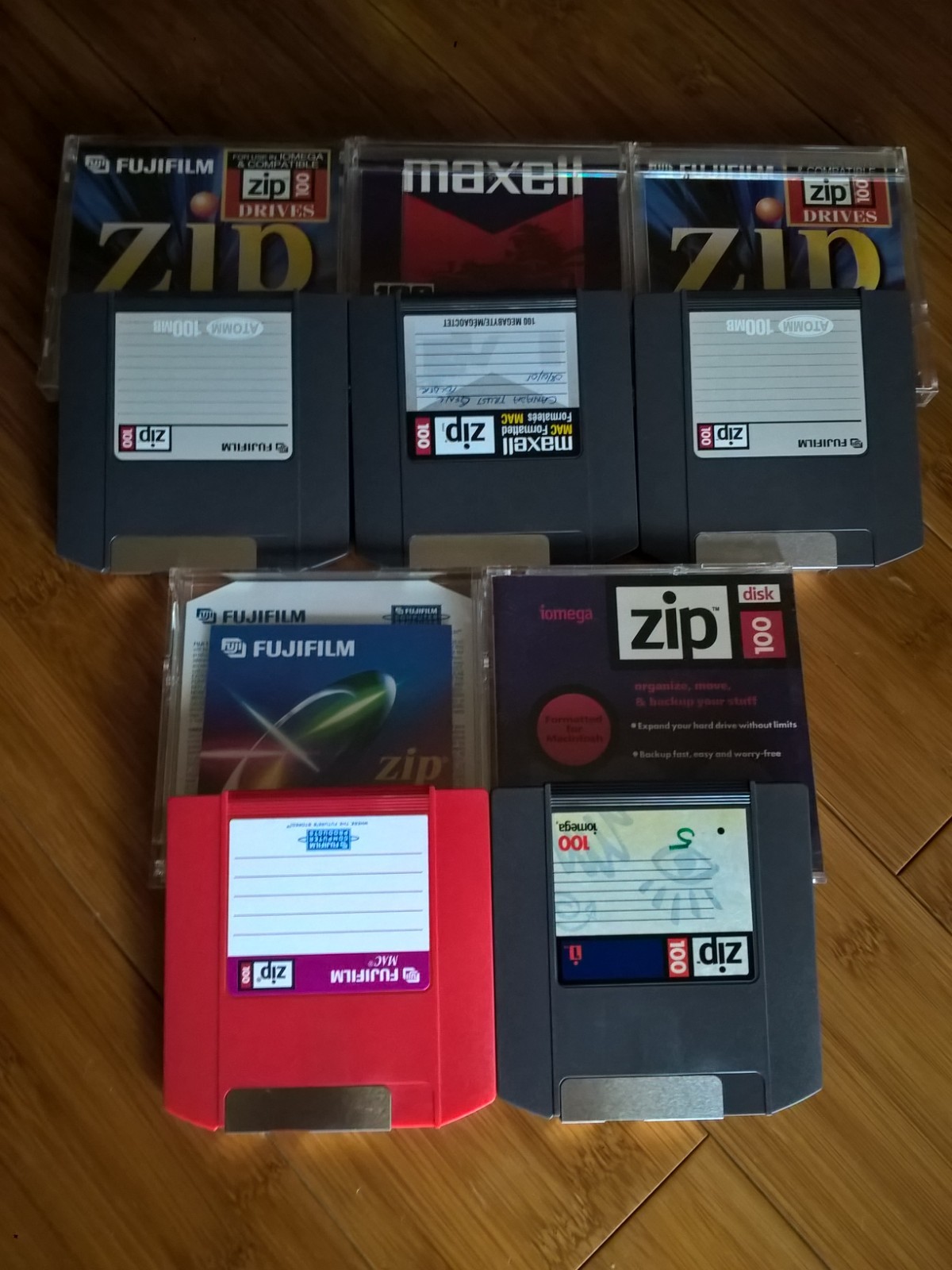
Description:============Similar to pictured, a lot of 5 zip 100mb disks. Includes five disks and five individual jewel cases. Exact brand may vary.
Warranty and Returns:=====================We understand that there may be compatibility issues, space constraints, or it just doesn’t look perfect. This item can be returned within 14-days for ANY reason. However, shipping to and from is not refundable.
Shipping:=========- Other shipping methods are available – contact us for details.- Combined shipping is available for most items – contact us for details.- Local pickup is also available at no cost.
About Us:=========The Computer Preservation Group is dedicated to the preservation of historical computers. To help fund ongoing operations, select items are made available. To learn more, please visit our website. Thank you for your support!
Stock#:J2751.GH#1Details from wikipedia:
The Zip drive is a removable floppy disk storage system that was announced by Iomega in 1994 and began shipping in March 1995.[1] Considered medium-to-high-capacity at the time of its release, Zip disks were originally launched with capacities of 100 MB, then 250 MB, and finally 750 MB.
The format became the most popular of the superfloppy products which filled a niche in the late 1990s portable storage market. However, it was never popular enough to replace the standard 3+1⁄2-inch floppy disk. Zip drives fell out of favor for mass portable storage during the early 2000s as CD-RW and USB flash drives became prevalent. The Zip brand later covered internal and external CD writers known as Zip-650 or Zip-CD, despite the dissimilar technology.
OverviewThe Zip drive is a "superfloppy" disk drive that has all of the standard 3+1⁄2-inch floppy drive's convenience, but with much greater capacity options and with performance that is much improved over a standard floppy drive. However, Zip disk housings are similar to but slightly larger than those of standard 3+1⁄2-inch floppy disks.[2]
In the Zip drive, the heads fly in a manner similar to a hard disk drive. A linear actuator uses the voice coil actuation technology related to modern hard disk drives.
The original Zip drive has a maximum data transfer rate of about 1.4 MB/s (comparable to 8× CD-R; although some connection methods are slower, down to approximately 50 kB/s for maximum-compatibility parallel "nibble" mode) and a seek time of 28 ms on average, compared to a standard 1.44 MB floppy's effective ≈16 kB/s and ≈200 ms average seek time. Typical desktop hard disk drives from mid-to-late 1990s revolve at 5,400 rpm and have transfer rates from 3 MB/s to 10 MB/s or more, and average seek times from 20 ms to 14 ms or less.[citation needed]
Early-generation Zip drives were in direct competition with the SuperDisk (LS-120) drives, which hold 20% more data and can also read standard 3+1⁄2-inch 1.44 MB diskettes, but they have a lower data-transfer rate due to lower rotational speed.[citation needed]
The Zip drive was Iomega's third generation of products, different from Iomega's earlier Bernoulli Boxes in many ways, including the absence of the Bernoulli plate of the earlier products.[3]