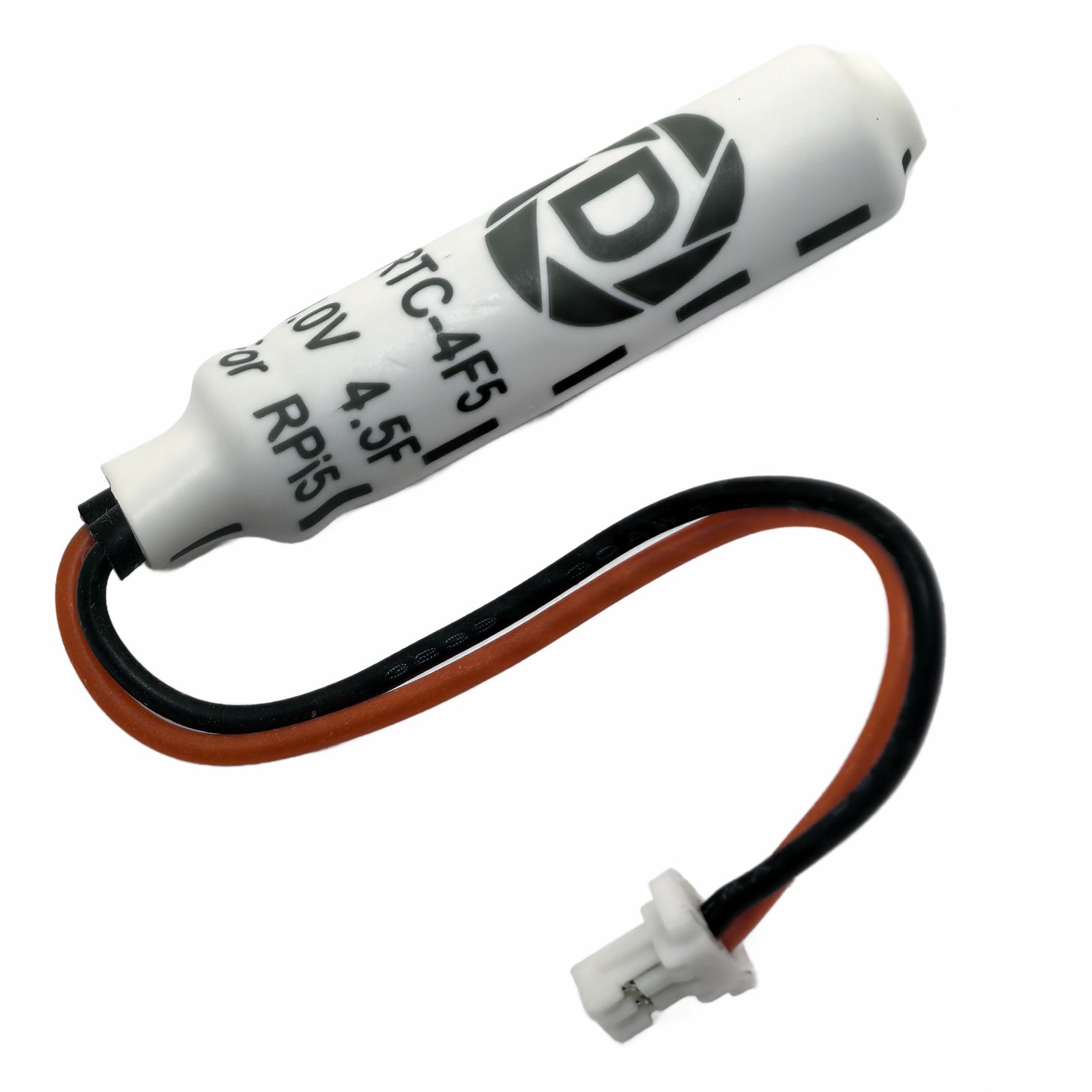
This is a 4.5F, 3.0V supercapacitor Real-Time Clock (RTC) backup module designed for the Raspberry Pi 5. It serves as a physical-layer alternative to chemical batteries (like the ML2020) for short-term timekeeping. Specific application scenarios include preventing clock failure during temporary power disconnections for maintenance in offline environments, or maintaining time synchronization while commuting from work to home. This module is especially suitable for Raspberry Pi 5 devices that run continuously for long periods but occasionally require short-term power-off maintenance.
Performance vs. ML2020 Battery The official ML2020 lithium battery offers months of absolute runtime but is subject to chemical aging and environmental limits. This supercapacitor module (10-14 days runtime) complements this with superior physical resilience:
- Wide Temperature Tolerance: Standard operating temperature ranges from -40°C to +65°C. Significant capacity degradation will only occur when operating continuously above this 65°C threshold.
- Zero Physical Aging: Based on pure physical charge storage, it delivers a lifecycle of 500,000 charge-discharge cycles. It completely eliminates the sudden capacity drops, over-discharge damage, and chemical leakage issues typical of aging coin cell batteries.
- Manufacturing Tolerances: Supercapacitors inherently possess a standard factory capacitance tolerance (-10% to +30% for this model). A nominal 4.5F component may vary within this acceptable physical range (4.05F to 5.85F), which, combined with temperature factors, accounts for the estimated 10-14 day backup window rather than a fixed absolute duration.
Dimensions and Installation The main body diameter is 7.2mm with a height of approximately 32mm. It connects via a JST-SH 1.0mm 2-pin connector. Due to its length, it fits well horizontally in the narrow space behind the USB ports and the heatsink. The included double-sided adhesive pad assists in securing the module. The soft silicone lead wires simplify routing in confined spaces without springing back out of shape.
Hardware Connection: Plug the JST-SH 1.0mm 2-pin connector into the J5 battery header (labeled "BAT") on the Pi 5 board. Ensure correct polarity during installation: the red positive wire must be positioned on the side closest to the Type-C power port.
Configuration and Usage Instructions (Crucial) The Raspberry Pi 5 provides a constant current (approx. 3mA) and constant voltage (CC/CV) charging mechanism for the RTC backup. Charging is disabled by default.
-
Enable Charging: Open the terminal and edit the boot configuration file. You must strictly set the charging voltage to 3.0V. Add the following line to /boot/firmware/config.txt: dtparam=rtc_bbat_vchg=3000000
-
Reboot: Restart the system for the changes to take effect.
-
Verify Configuration: Check the target charging voltage using this command: cat (The output should be 3000000, representing 3.0V).
-
Monitor Current Voltage: Read the real-time terminal voltage of the supercapacitor via the Power Management IC (PMIC) using this command: vcgencmd pmic_read_adc BATT_V (Output example: BATT_V volt(25)=2.99828800V. Note: Due to PMIC ADC logic, readings will be inaccurately low or missing when actual voltage is below 2V, and will become accurate once it exceeds 2.8V.)
Charging Time and Voltage Warnings Due to the larger 4.5F capacity, at a 3mA constant current, the capacitor will require approximately 1.5 to 2 hours to reach the 3.0V threshold. To achieve full internal charge saturation and the maximum 10-14 day runtime, the system should remain powered on for an extended period.
Warning: The absolute maximum withstand voltage of this supercapacitor is 3.15V. Setting a charging voltage higher than 3.0V in the configuration file will exceed the physical limits of the component, leading to electrolyte leakage, structural swelling, or permanent failure.